Self-Deception: The Stories We Tell Ourselves
We’re surprisingly good at fooling ourselves: about our mistakes, our motives and our habits. Here’s why the mind does it, and simple ways to see yourself a little more honestly.
4 min read
In this article7 sections · showhide
“I’ll start on Monday.” “I only check my phone when I need to.” “That argument wasn’t really my fault.” “I’m not angry, I’m just tired.”
Most of us say things like this regularly, and most of the time we believe them. That’s what makes self-deception different from ordinary lying: the person being fooled is ourselves.
The physicist Richard Feynman, speaking to students in 1974, put it neatly: “The first principle is that you must not fool yourself, and you are the easiest person to fool.”
Why the mind fools itself
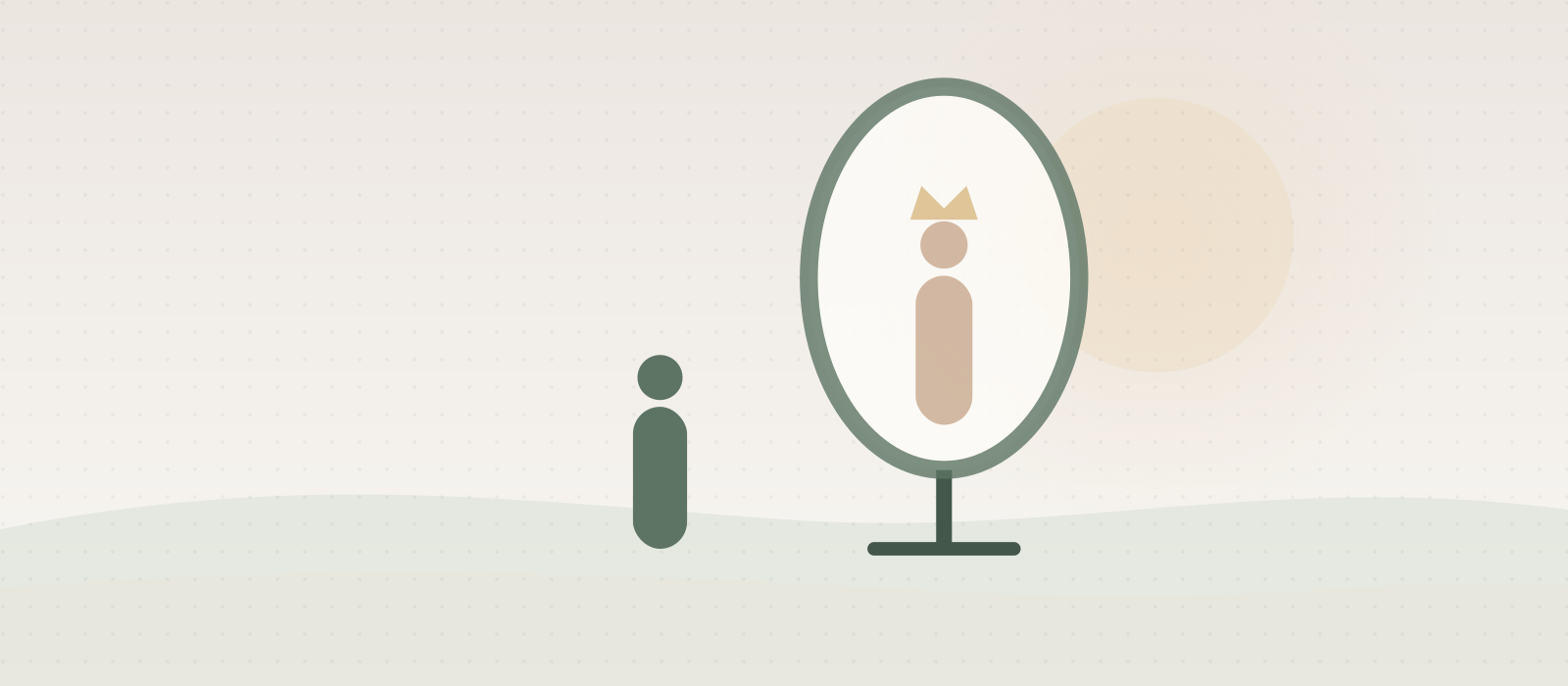
Self-deception isn’t a sign of weakness. It’s a normal part of how human minds work, and it often serves a purpose: protecting our sense of being a good, competent, consistent person.
Cognitive dissonance
In the 1950s, psychologist Leon Festinger described cognitive dissonance: the discomfort we feel when our actions don’t match our beliefs. If I believe I’m healthy but I smoke, something has to give. Quitting is hard, so it’s often easier to change the belief: “It’s only a few a day”, “My grandfather smoked and lived to ninety.”
Social psychologists Carol Tavris and Elliot Aronson describe how this works in their book Mistakes Were Made (but Not by Me). Each small justification makes the next one easier, until we’ve built a whole story that keeps us comfortable and keeps us from changing.
The bias blind spot
In 2002, Emily Pronin, Daniel Lin and Lee Ross showed that people readily recognise biases in others but rate themselves as less biased than average. We see other people’s self-deception clearly. Our own is much harder to spot, which is exactly why it works.
Protecting the ego
Admitting a mistake can feel like a threat to who we are. So the mind finds ways around it: blaming circumstances, remembering events in a more flattering way, or simply not looking too closely.
Common forms of self-deception
- “Later” thinking. “I’ll deal with it next month” when we know we won’t.
- Selective memory. Remembering our good intentions clearly and our actual behaviour vaguely.
- Flattering explanations. “I failed because the test was unfair” versus “They failed because they didn’t prepare”.
- Busy-ness as avoidance. Staying constantly occupied so there’s no time to face a difficult question.
- Labels that excuse. “I’m just a perfectionist” when the real issue is fear of being judged.
“The first principle is that you must not fool yourself, and you are the easiest person to fool.”
How to see yourself more honestly
You can’t switch self-deception off completely, and you wouldn’t want to: a little kindness towards ourselves is healthy. But you can create a few honest checkpoints.
Look at behaviour, not intentions
Intentions are easy to remember generously. Behaviour is harder to argue with. If you want to know what you value, look at where your time and money actually went last week.
Write it down
Keep a simple record of one thing you want to understand, such as hours slept, screen time or money spent. Numbers on paper are much harder to reinterpret than vague memories.
Ask a trusted person
Choose someone who cares about you and is honest. Ask: “Is there something about how I handle this that I might not be seeing?” Then listen without defending yourself, even if it stings.
Notice the “but”
When you hear yourself say “I know I should, but…”, pause. What comes after the “but” is often the story that keeps you stuck.
Make it safe to be wrong
The more we treat mistakes as disasters, the harder we work to hide them, even from ourselves. Talking to yourself kindly (“That didn’t go well; what can I learn?”) makes honesty less threatening.
A gentle note
Seeing your own blind spots can be uncomfortable. The goal isn’t to judge yourself harshly; it’s to see more clearly, so you can make better choices. Honesty and kindness work best together.
Frequently asked questions
Is all self-deception harmful?
Not always. Mild optimism, such as believing you’ll handle a challenge a little better than the odds suggest, can help you persevere. Self-deception becomes harmful when it stops you from fixing real problems.
How can I tell if I’m fooling myself?
Clues include feeling defensive when a topic comes up, avoiding certain facts, or noticing a repeated gap between what you say and what you do.
Why is it easier to see in others?
We judge others by their actions but ourselves by our intentions. That’s the essence of the bias blind spot.
A small step for today
Think of one thing you’ve been meaning to do for a long time. Finish this sentence honestly on paper: “The real reason I haven’t done it is…”. Don’t judge the answer. Just let it be seen.
Sources and further reading
- Festinger, L. (1957). A Theory of Cognitive Dissonance. Stanford University Press.
- Tavris, C., & Aronson, E. (2007). Mistakes Were Made (but Not by Me). Harcourt.
- Pronin, E., Lin, D. Y., & Ross, L. (2002). The bias blind spot: Perceptions of bias in self versus others. Personality and Social Psychology Bulletin, 28(3), 369–381.
- Feynman, R. P. (1974). Cargo Cult Science. Commencement address, California Institute of Technology.
Found this helpful? Share it with someone who needs it.
🪞 Reading path: Know yourself3 of 4
 Up nextWho Am I? A Beginner’s Guide to Self-Inquiry
This article is for general information and is not a substitute for professional advice. If you’re struggling, please reach out to a qualified professional or, in India, call the free Tele-MANAS mental health helpline on 14416. See our Disclaimer.
Keep reading

Human Nature
The Spotlight Effect: People Notice You Far Less Than You Think
Sure everyone saw your mistake? Research shows we hugely overestimate how much others notice us. Here’s how to use that to feel lighter and braver.
5 min read
Human Nature
Negativity Bias: Why Your Mind Holds On to the Bad More Than the Good
One harsh comment can outweigh ten compliments. Here’s why your brain gives bad moments extra weight, and gentle, practical ways to give the good a fair hearing.
6 min read

Reflections
The Courage to Be a Beginner Again
As adults, we rarely let ourselves be bad at something. Learning an instrument, a language or a sport at 35 or 60 takes a particular kind of courage. A reflection on beginnings, ego and growth.
4 min read