How Long Does It Really Take to Build a Habit? (Hint: Not 21 Days)
The “21 days to form a habit” rule is a myth. Research suggests it often takes around two months, and missing a day won’t ruin your progress. Here’s how to make habits stick.
5 min read
In this article9 sections · showhide
It’s the first week of January, or the first day of a new month, or simply a Monday. You decide that this time you’ll really do it: wake up early, go for a walk, read before bed, drink more water. Someone tells you that if you can keep it up for 21 days, it will become automatic.
Day 22 arrives, and it doesn’t feel automatic at all. It still feels like effort. So you wonder whether something is wrong with you.
Nothing is wrong with you. The 21-day rule is a myth, and the real story is far more forgiving.
Where the 21-day idea came from
The number is usually traced back to Maxwell Maltz, a plastic surgeon who wrote a bestselling self-help book called Psycho-Cybernetics in 1960. He noticed that his patients seemed to take a minimum of about 21 days to get used to a change, such as a new face after surgery.
Over the years, “a minimum of about 21 days to adjust” was simplified and repeated until it became “21 days to form a habit.” That’s a much bigger claim, and Maltz’s observation never supported it.
What the research actually found
In 2010, health psychologist Phillippa Lally and her colleagues at University College London published one of the best-known studies on how habits form in real life. They followed 96 volunteers who each chose a new daily behaviour, such as drinking a glass of water with lunch, eating a piece of fruit, or going for a short run before dinner. Every day, participants reported how automatic the behaviour felt.
On average, it took 66 days for a behaviour to reach its peak level of automaticity. But the range was enormous, from 18 days to an estimated 254 days, depending on the person and the habit. Simple habits, like a glass of water, became automatic faster than more demanding ones, like exercise.
So if your new habit still feels like work after three weeks, you’re right on schedule.
If your new habit still feels like work after three weeks, you’re right on schedule.
The most encouraging finding
The same study found that missing a single day did not meaningfully harm the habit-forming process. Consistency matters over time; perfection doesn’t.
That means one bad day isn’t failure. The real danger is the story we tell ourselves afterwards: “I’ve broken my streak, so what’s the point?” A helpful rule many people use is simple: never miss twice in a row.
Why habits matter so much
Habits do more of our living than we realise. Research by psychologist Wendy Wood and colleagues suggests that a large share of our everyday actions, roughly 40 percent in one well-known study, are performed out of habit, often while we’re thinking about something else. Build good habits, and a lot of your life quietly improves on autopilot.
How to make a new habit stick
Start tiny
Make the habit so small it feels almost too easy: one push-up, one page of a book, one minute of meditation. Behaviour scientist BJ Fogg, author of Tiny Habits, argues that starting small removes the need for willpower and lets the habit take root.
Anchor it to something you already do
Attach the new habit to an existing routine: “After I brush my teeth, I’ll do one minute of stretching.” “After I pour my morning chai, I’ll write one line in my journal.” Psychologist Peter Gollwitzer calls plans like this “implementation intentions,” and research shows they make people much more likely to follow through.
Keep the same time and place
Doing a habit in the same context helps your brain link the situation to the behaviour, which is exactly how automaticity grows.
Make it easy to see and easy to start
Put your book on your pillow. Leave your walking shoes by the door. Keep a water bottle on your desk. Small changes to your surroundings can do more than motivation.
Track gently
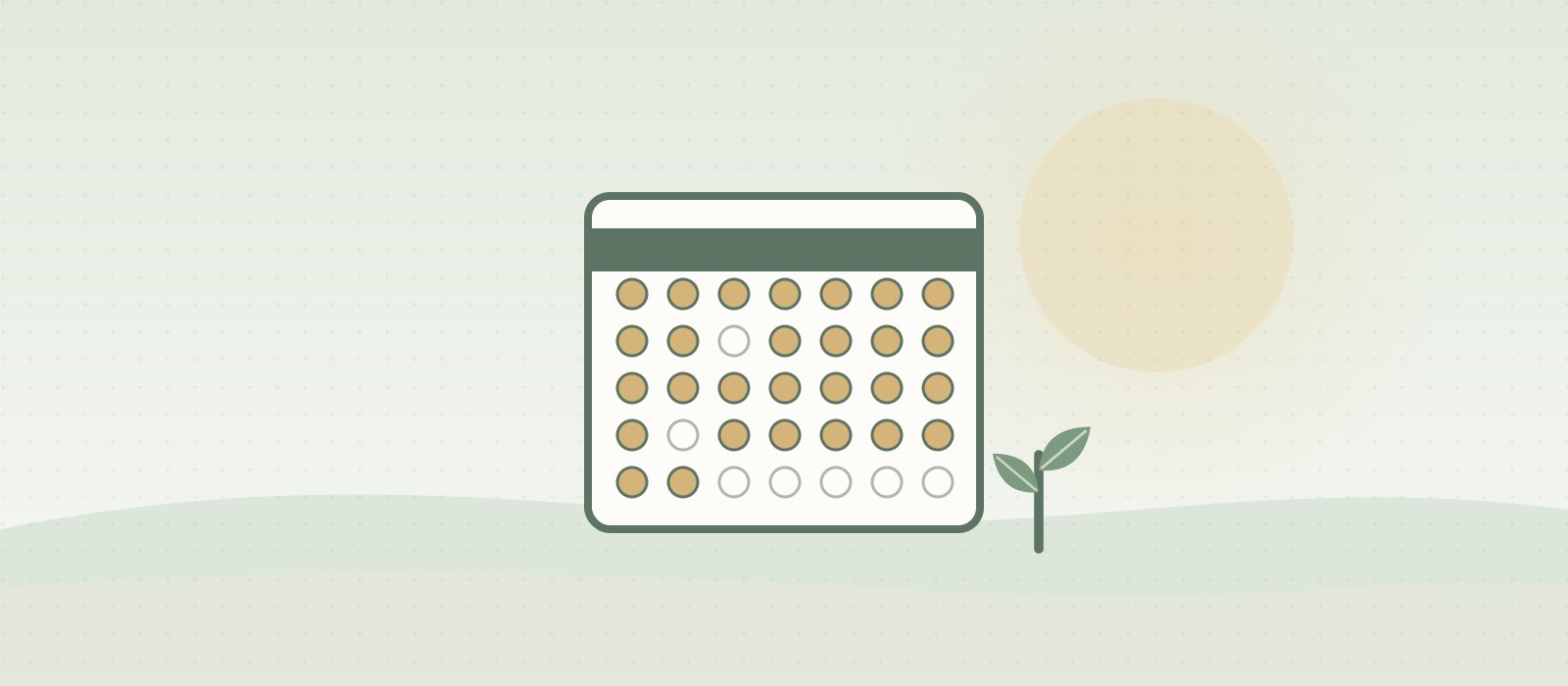
A simple tick on a calendar is satisfying and motivating. But treat gaps as information, not a judgement. Ask, “What got in the way?” rather than “What’s wrong with me?”
Plan for a couple of months, not a couple of weeks
Expecting a habit to take around two months, with a few slips along the way, makes you far less likely to give up just as it’s starting to form.
Common mistakes to avoid
- Starting with too many habits at once. Choose one, or two at most. Add more once the first feels natural.
- Relying on motivation. Motivation comes and goes. Systems, cues and tiny starts are more reliable.
- Making it a punishment. Habits stick better when they feel good or rewarding. Find a version you can enjoy.
- All-or-nothing thinking. Five minutes of exercise on a busy day still counts. It keeps the habit alive.
Frequently asked questions
So how many days should I aim for?
There’s no magic number. A rough guide is two to three months for a habit to feel natural, but simple habits can take less time and harder ones more. Focus on showing up, not on counting days.
What if I miss a whole week?
Simply start again, ideally with an even smaller version of the habit. Many people restart several times before a habit sticks. That isn’t failure; it’s how change usually happens.
Can I break a bad habit the same way?
Similar principles help. Make the unwanted habit harder to do (put the phone in another room at night) and replace it with something easier and better (keep a book on your bedside table instead).
Reframing the journey
Lasting change is less like flipping a switch and more like wearing a path through a grassy field. The first few walks barely leave a mark. But every time you walk the same way, the path gets a little clearer, until one day you follow it without thinking. Be patient with your path.
Sources and further reading
- Lally, P., van Jaarsveld, C. H. M., Potts, H. W. W., & Wardle, J. (2010). How are habits formed: Modelling habit formation in the real world. European Journal of Social Psychology.
- Wood, W., Quinn, J. M., & Kashy, D. A. (2002). Habits in everyday life: Thought, emotion, and action. Journal of Personality and Social Psychology.
- Gollwitzer, P. M. (1999). Implementation intentions: Strong effects of simple plans. American Psychologist.
- Fogg, B. J. (2019). Tiny Habits. Houghton Mifflin Harcourt.
Found this helpful? Share it with someone who needs it.
🌱 Reading path: Build better habits2 of 5
 Up nextDelayed Gratification: What the Marshmallow Test Really Tells Us
Keep reading
Discipline
If-Then Plans: The Simple Trick That Helps You Follow Through
Good intentions often fade by Wednesday. Psychologists have found that a tiny change, deciding exactly when and where you’ll act, makes follow-through far more likely. Here’s how to use if-then plans.
5 min read
Discipline
How to Protect Your Attention in a Distracted World
Your attention is the raw material of your life, and everything wants a piece of it. Here’s what research says about interruptions and phones, and simple ways to get your focus back.
5 min read
Discipline
The Two-Minute Rule: A Simple, Kind Way to Beat Procrastination
Big tasks feel heavy, so we put them off. The two-minute rule makes starting so easy you can’t say no, and starting is usually the hardest part.
5 min read